What are “Tropical Cyclones”?

Tropical Cyclones (also known as “Typhoons” in the western Pacific Ocean, “Hurricanes” in the Atlantic Ocean, or simply “Cyclones” in the Indian Ocean) can form anywhere when certain conditions are met.
Factors Leading to Tropical Cyclones
A tropical cyclone is triggered in presence of a suitably deep warm water, which is a source of latent heat and high humidity level. It also requires presence of very low atmospheric pressure, as well as the presence of adequately strong vertical wind shear, typically caused by the formation of cumulonimbus clouds (i.e. is a dense, towering vertical cloud associated with thunderstorms and atmospheric instability, forming from water vapour carried by powerful upward air currents).
Effects of Cyclones in the South China Sea
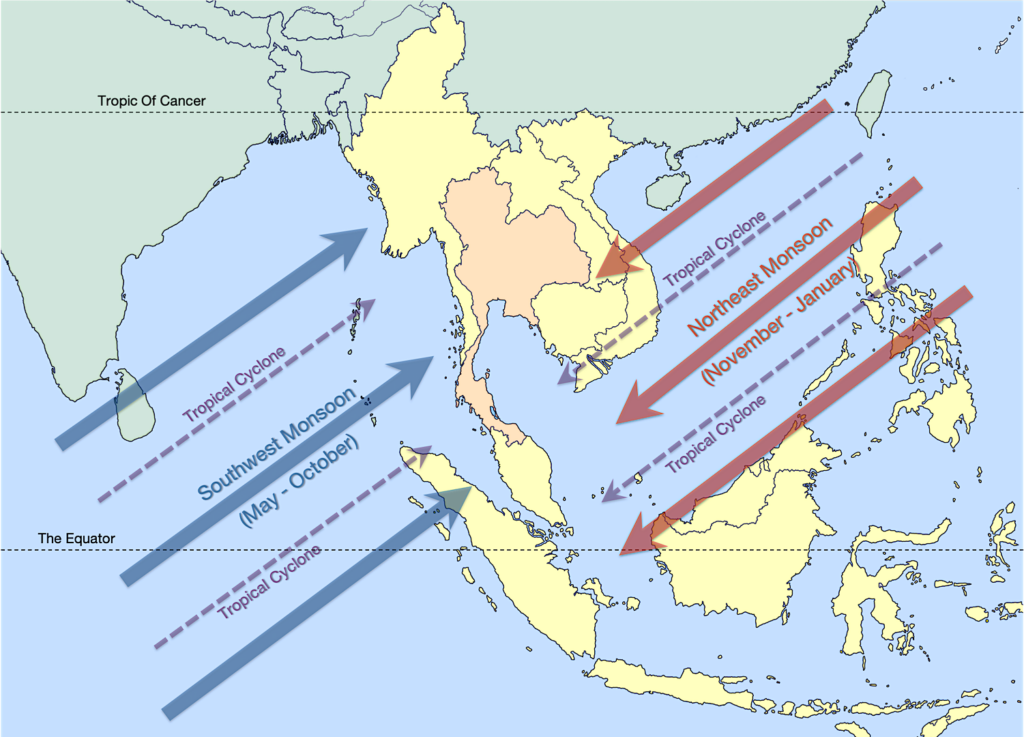
Typhoons occur all year round over the northern South China Sea. However, the “Typhoon Season” is considered to be from the autumn transition (October) to the first half of the Northeast (Winter) Monsoon (November – December), when they occur most frequently in the South China Sea.
Typhoons that occur during the Southwest (Summer) Monsoon usually form well east of the Philippines Islands. These systems initially move to the northwest towards Taiwan, but recurve sharply to the northeast into southern Japan later in the season. Such typhoons indirectly influence the South China Sea by causing “surges” in the Southwest monsoonal flow, resulting in sea surges and sudden strong winds over the South China Sea. Later in the year, from October to December, typhoons track westwards, crossing the Philippines into the South China Sea. These westward moving storms occur progressively farther south towards the end of the season. Although there are exceptions, typhoons are mainly confined to above latitude 10°N.
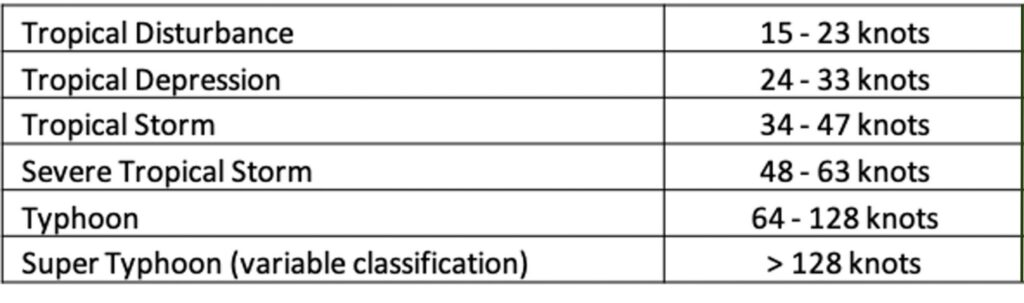
Tropical Cyclones are categorised according to maximum sustained wind speed close to the storm’s centre. The scale used for the northwest Pacific, including the South China Sea comes from the Japanese Meteorological Agency, which classifies storms based on their 10-minute winds (ie, wind speeds averaged over 10 minutes):