
The Association of Southeast Asian Nations (ASEAN)

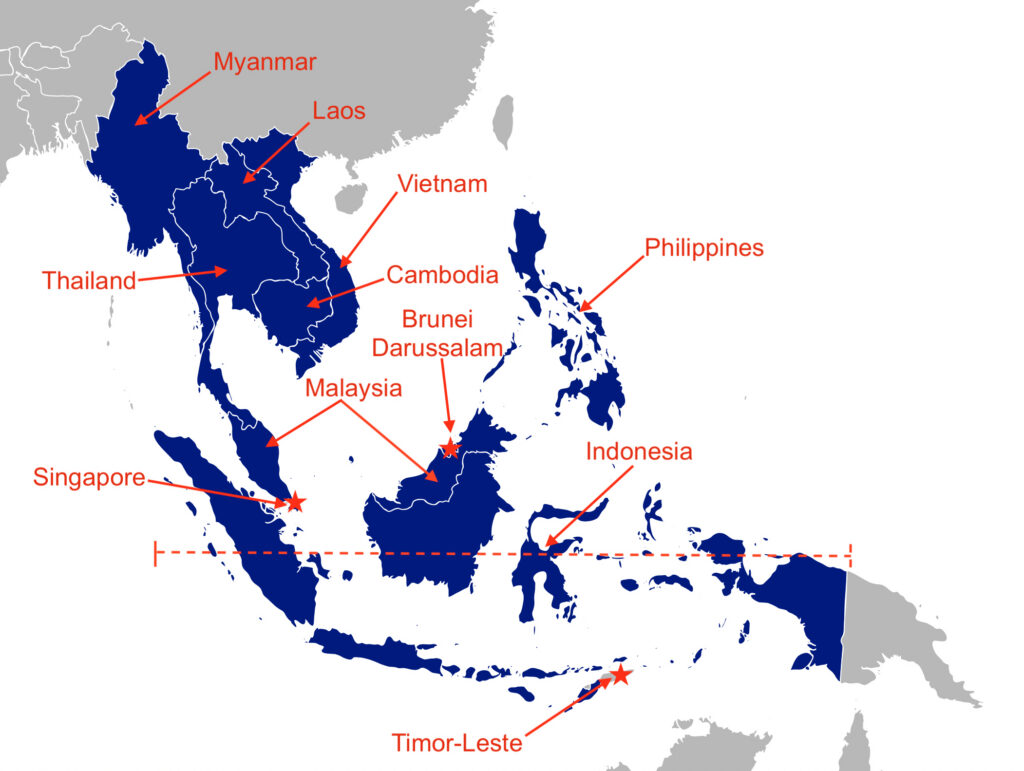
The Association of South-East Asian Nations (ASEAN), was established on 8 August 1967 in Bangkok as an inter-governmental organization for regional cooperation based on the Declaration of the Establishment of ASEAN (commonly known as the Bangkok Declaration) to promote regional peace and stability and economic growth. . Its primary objectives are to promote political cooperation and stability, trade and economic growth, as well as the social development of member countries. The ASEAN Secretariat was established at the ASEAN Summit in 1976 with its headquarter in Jakarta, Indonesia.
ASEAN initially comprised 5 founding member countries – Indonesia, Malaysia, the Philippines, Singapore, and Thailand, and later expanded to 10 member countries to cover almost the entire Southeast Asia with Brunei Darussalam (1995), Viet Nam (1995), Lao PDR (1997), Myanmar (1997), and Cambodia (1999) successively joining. Timor-Leste joined In October 2025 to make a total of 11 country members today.
ASEAN has progressively evolved throughout the years. Cooperation under ASEAN initially focused on fostering political stability within the region. After the region became more politically stable, the focus then shifted towards economic cooperation, which led to the establishment of the ASEAN Economic Community (AEC) in 2017. ASEAN is the world’s 5th largest economy. In 2021, ASEAN had a population of 663.81 million people and GDP of approximately US$3.3 trillion, accounting for 3.5% of world GDP.
The ASEAN Economic Community is expected to help facilitate business and investment within ASEAN by lowering costs, while at the same time utilising each member’s economic strengths to support and enhance member countries’ productivity. Furthermore, border trade with neighbouring countries remains an important mechanism in driving economic growth for provinces along the border, and ASEAN is considered Thailand’s largest export market, at around a quarter of the country’s total exports.