Thailand’s Governmental
Structure
The governance of Thailand is by our particular model of constitutional monarchy. The King is the sovereign head of state, and the immediate members of the monarchy are respected as spiritual leaders of the nation. However, the king, as specify in the Thai Constitution, does not participate in politics. Political leadership is the responsibilities of elected government officials at their respective bureaucratic levels, the highest office of which is that of the Prime Minister. As per the Constitution, Thailand’s election is held every four years.
Government administration of Thailand is in four tiers, i.e.
- The National Government
- The Provincial Governments [changwat / จังหวัด]
- The Local District Administrations
[Amphur / อำเภอ (Khet / เขต in Bangkok)] - The Local Sub-district Administration
[Tambon / ตำบล (Khwang / แขวง in Bangkok)]
The Provincial Governments are directly accountable to the National Government, the District Administrations are accountable to their respective Provincial Governments, and the Sub-districts are in turn accountable to their respective Districts.
As of 2025, Thailand has 76 provinces, not including the capital city (equivalent to a province) of Bangkok.
Due to its size and it being the national capital, Bangkok’s administration has its own special form of governmental administration. For example, the Governor of Bangkok is elected by the registered residents of the city, whereas the governors of the 76 provinces are appointed by the Minister of the Interior with approval from the National Cabinet.
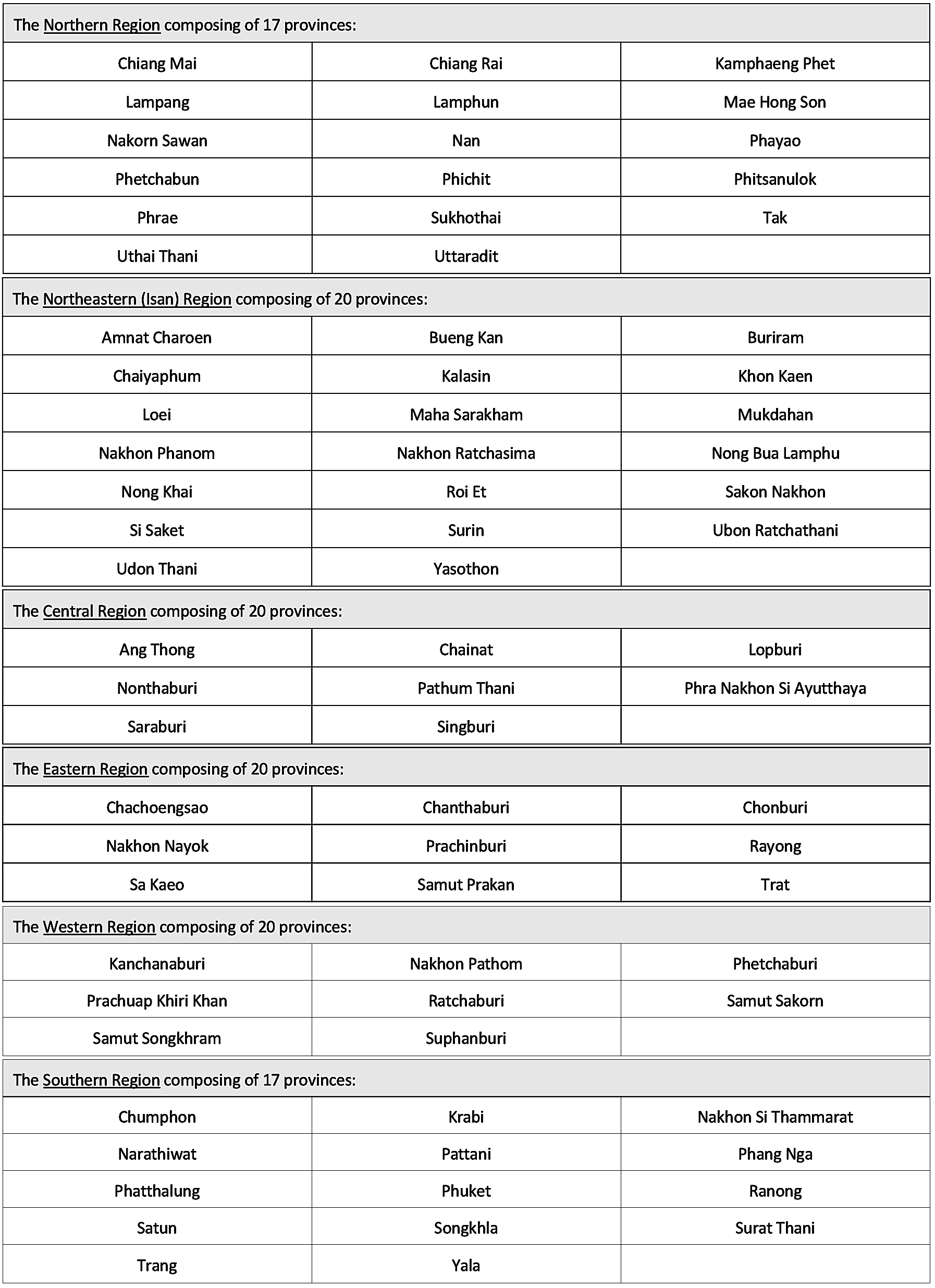
The 76 provinces are grouped into regional areas for administrative purposes. However, there are several grouping schemes that are used, each by a different governmental agency to serve its specific purposes, e.g. Thai Meteorological Department (weather forecasting & monitoring), Department of Highways (road construction & maintenance), Office of The National Broadcasting and Telecommunications Commission (telephone area codes), Thailand Post Public Company Limited (postal codes), etc. The regional grouping scheme that is most widely adopted (both officially and unofficially) is by Thailand’s main governmental think-tank, The National Economic and Social Development Board (NESDB).
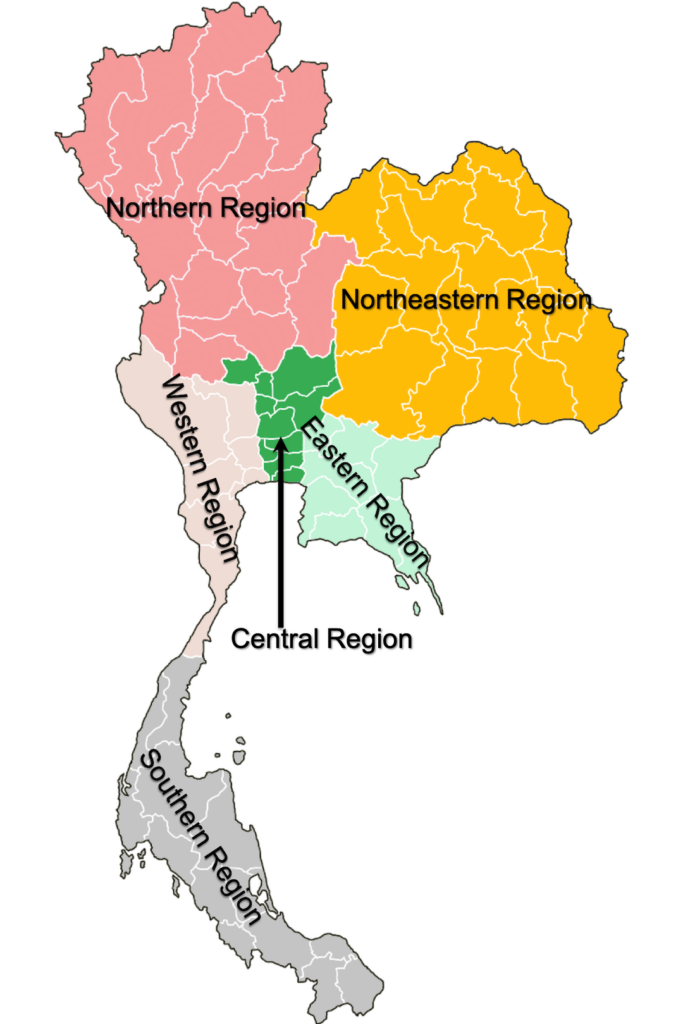
The NESDB scheme divides the country into six administrative regions and 76 provinces, which, again, does not include the capital city of Bangkok, as follows: