
What are “Tropical Monsoons”?
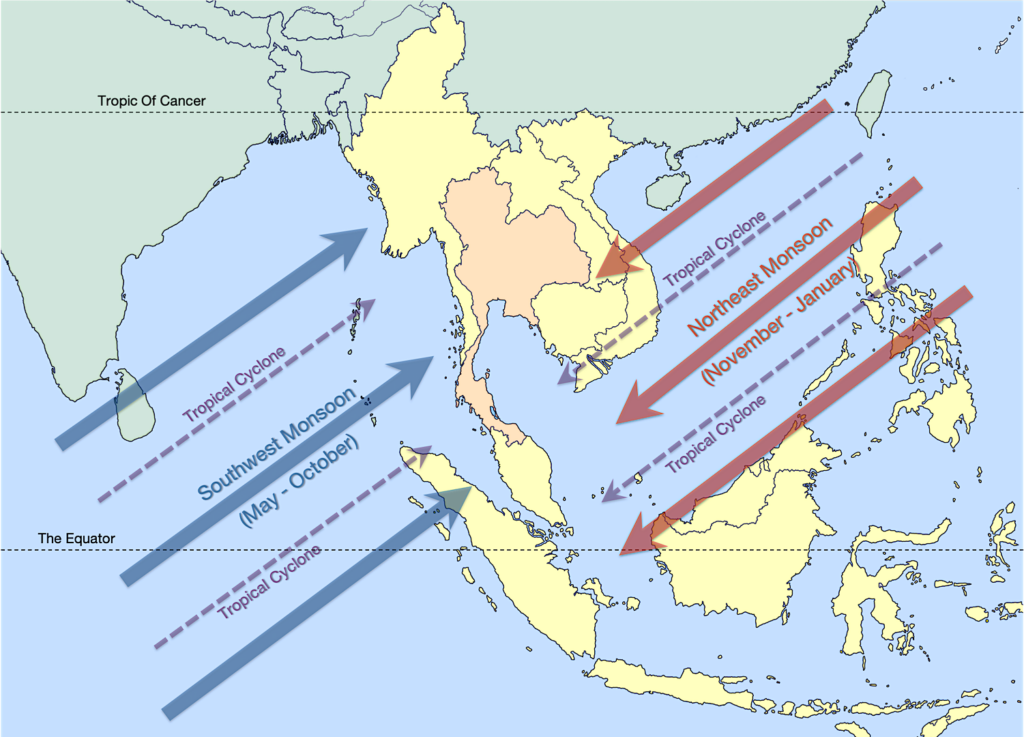
A “tropical monsoon” is a seasonal shift in the prevailing wind direction in Earth’s tropical regions. This wind direction is caused by the difference in temperature of a large land mass (typically a continent) and temperature of a large body of water (typically an ocean). Monsoon winds always blow from cold to warm regions. The monsoons cause wet and dry seasons in the region that they affected.
The temperature differences are caused by two major factors:
- The varying strength of the sun’s ray in summer and winter; and
- The seasonal shifting of the Intertropical Convergence Zone (ITCZ), also known as the Monsoon Zone, which is a belt of low-pressure air currents that circle the Earth at the vicinity of the Equator, usually between the Tropic of Cancer and the Tropic of Capricorn.
The term “monsoon” almost always refers to the Asian tropical monsoon, which covers a large region extending from the Indian Sub-Continent to Southeast Asia where monsoon conditions prevail. (Note: A weaker and much more localised monsoon also occurs over the normally dry southwestern United States in the late summer when more humid air, accompanied by thunderstorms, overspreads the region.)
For East Asia, there are two types of monsoons, the summer monsoon and the winter monsoon . . .
The Summer Monsoon
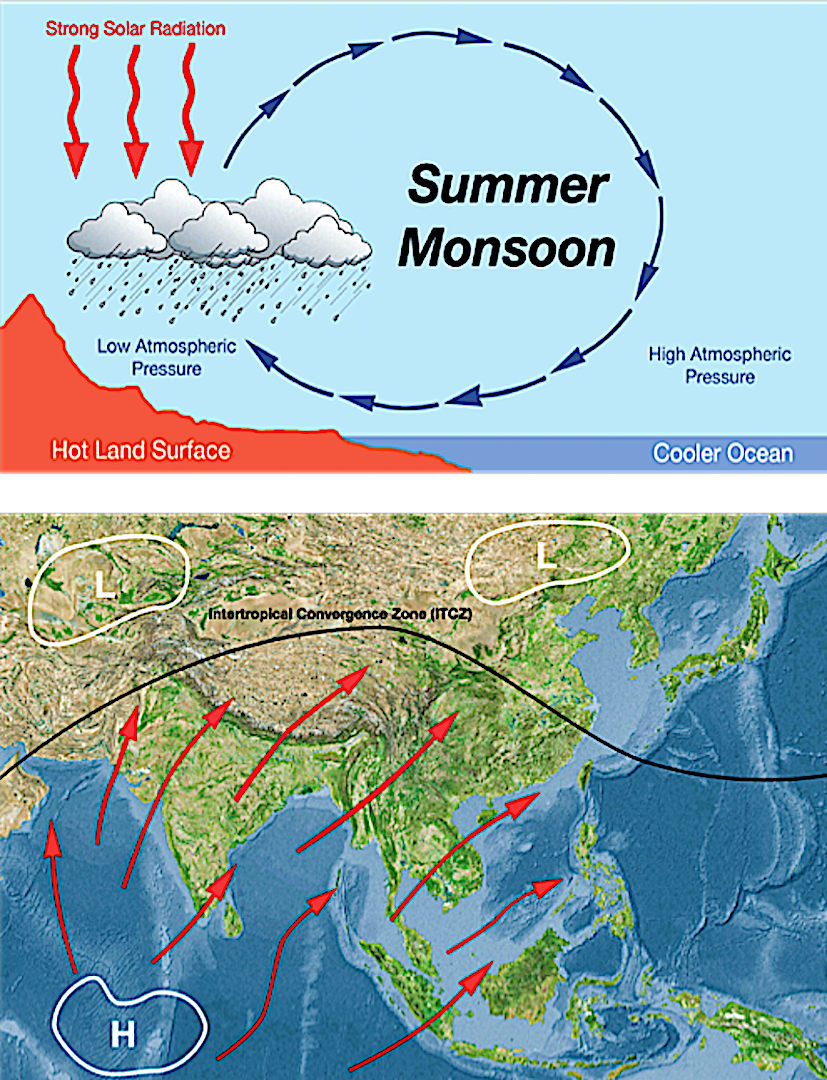
Around May and June of each year, the summer monsoon arrives with persistent south-westerly wind flow that is driven by a warm air mass with low pressure at the land mass surface of South and Southeast Asia as it is warmed by the sun. Air from the relatively higher-pressure air mass over the Indian Ocean and tropical western Pacific Ocean flows northward toward the low pressure over land, bring with it torrential rains.
Also, with the onset of summer, the Intertropical Convergence Zone (ITCZ) migrates northward and draws warm, moist air onto the land mass.
The Winter Monsoon
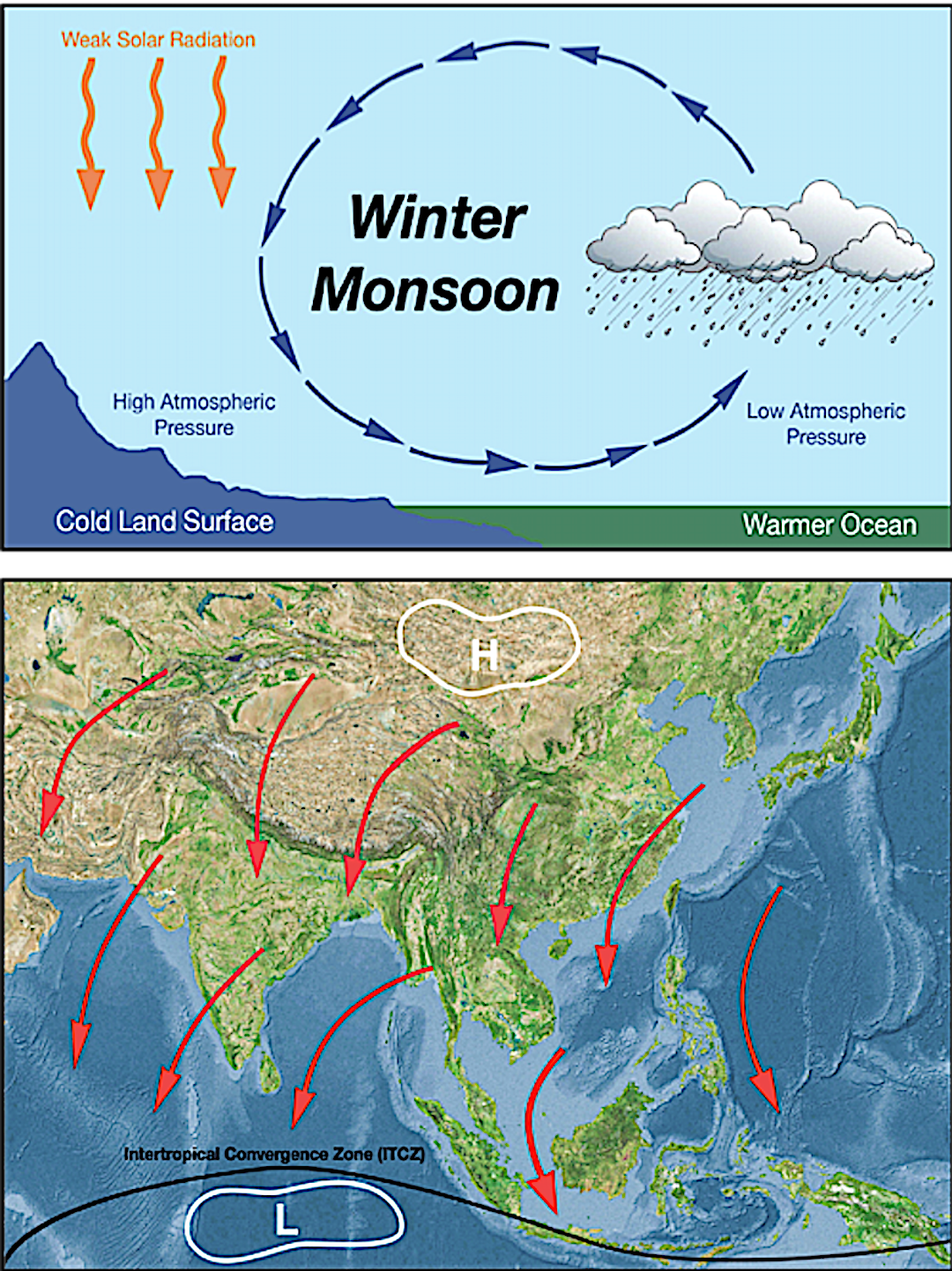
The Asian winter monsoon, which lasts from October to April, is less well-known than its rainy summer equivalent. Being in the Northern Hemisphere, the Asian land mass in winter is cold and the Intertropical Convergence Zone (ITCZ) migrates southward. These two factors cause the dry winter monsoon wind to blows from the northeast. These winds start in the air above Mongolia and north-western China.
Winter monsoons are less powerful than summer monsoons in South and Southeast Asia, in part because the Himalaya Mountains prevent much of the wind and moisture of the monsoons from reaching the coast. The Himalayas also prevent much of the cool air from reaching places like southern India and Sri Lanka, keeping them warm all year. Winter monsoons are sometimes associated with droughts.
Not all winter monsoons are dry, however. Unlike the western part of Southeast Asia, the eastern, Pacific coast of Southeast Asia experiences its rainy season in the winter. The winter monsoon brings moist air from the South China Sea to areas like Southern Thailand, Malaysia and Indonesia.